
[RPi5] How to install LibreELEC on NVMe SSD?

  • Hi.

    As i reconfigure stuff at home i bought a new case for the space to connect a poe/m2 hat in it (main reason was to try the poe part) and as i have a spare nvme i want to install libreelec onto it and remove the existing sd card.

    Problem, i do not have a m2 to usb adapter (or rather, i have a usb m2 enclosure with a nvme in it, but as i do not have spare thermal pads for it i only would try that as a last resort) to copy the image onto it for a fresh install, i did not found anything in the install guide of the wiki regarding that scenario (or overlooked it),.


    I tought of creating a install on the mentioned "external" m2, copy those files onto the nvme trough kodi, remove the sd card and hope that it boots & installs trough the hat nvme.

    Would that work?

    If not, what would be the easiest other way to achieve that without the use of a M2 to usb adapter?

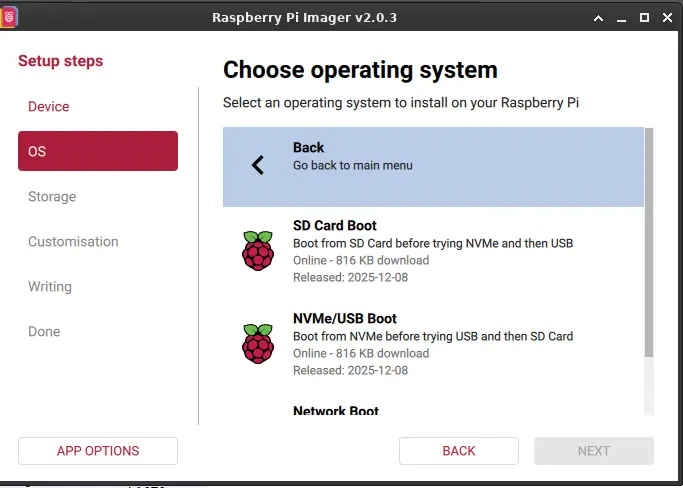
  • Is this on a RPi5? If yes, just use it's netinstall feature.

    Make sure the bootloader EEPROM is up-to-date, power it up with keyboard , mouse and ethernet cable connected and press "shift" to start the installer / RPi Imager.

    so long,

    Hias

  • As i reconfigure stuff at home i bought a new case for the space to connect a poe/m2 hat in it (main reason was to try the poe part) and as i have a spare nvme i want to install libreelec onto it and remove the existing sd card.

    Hi, usually I like to have the "system" and "data" in two different device. And who had trouble with saving/restoring or even loosing huge amount of data after a "problematic" update/upgrade, would agee with me. I would let the OS (LE) in a good and fast SD card, and storing all of media files on that SSD. But this is only my point of view...

  • I run LE from an nvme drive on an RPi5 and it works fine. Just boot the RPi from SD card, write the LE image to the nvme drive using dd, then set the boot config changes needed, power off and remove the SD card, power on again.

  • Is this on a RPi5? If yes, just use it's netinstall feature.

    Make sure the bootloader EEPROM is up-to-date, power it up with keyboard , mouse and ethernet cable connected and press "shift" to start the installer / RPi Imager.

    so long,

    Hias


    I will look into that, might be that i need to use the external enclosure either way even if it do want to.

    Either the cable from m2 hat to pi5 board is not sitting correct (the build manual unfortunately does not state if the led only indictates power of the poe function, or a working m2 connection), or kodi does not like the file system which is used (used it for a few months as a read cache in a synology nas......back when 256GB gen3 drives cost me only 20€ to experiment for that)

    Hi, usually I like to have the "system" and "data" in two different device. And who had trouble with saving/restoring or even loosing huge amount of data after a "problematic" update/upgrade, would agee with me. I would let the OS (LE) in a good and fast SD card, and storing all of media files on that SSD. But this is only my point of view...

    I have all my stuff on a NAS, so apart from librelec/kodi itself there is not much on the sd either way

  • I have all my stuff on a NAS, so apart from librelec/kodi itself there is not much on the sd either way

    For LE installation in that case enough 1-2GB space... a 128GB or bigger SSD isn't a waste for this? The gain? 1-2 seconds of booting time? When comparing with the SSD, I talking about a good SD card like a Samsung EVO Plus or Kingston Canvas Go Plus. To repeat myself: But this is only my point of view...

  • For LE installation in that case enough 1-2GB space...

    That's very tight, my .kodi folder is about 2GB (thumbnails take quite a bit of space) and I don't have a large music/video library.

    Calculate at least 8-16GB of space for the storage partition, remember you also need quite a bit of scratch space - eg Widevine updates need to download and store large image files, kodi updates need space for database migrations (which results in separate, new database files) etc.

    No big deal with current SD cards which are 32GB and up.

    so long,

    Hias

  • For LE installation in that case enough 1-2GB space... a 128GB or bigger SSD isn't a waste for this? The gain? 1-2 seconds of booting time? When comparing with the SSD, I talking about a good SD card like a Samsung EVO Plus or Kingston Canvas Go Plus. To repeat myself: But this is only my point of view...


    As mentioned in the first post, it is a spare nvme which i tried in my nas as a cache, but in my use case it does not make any difference. And as that nvme only had cost me 20€ a few months ago (otherwise i had not tried that cache thing at all) and was effectively cheaper as a 64GB sd card....and who knows what i need to store additionally direct on disc.


    Main Part of post:


    Got the install on the nvme working over the weekend, but it was not that fast and easy as hoped.

    First i had to format the nvme and put it in the external enclosure (was lucky that the pad on the inserted nvme did not sat at the case, so i could take it out and back in without problems), as neither the pi, or windows could see the file system used by synology.


    At the same time i put the image with the imager onto it, back into the pi and booted with the sd card to see if it gets seen which was the case.

    Booted without the sd card, got into the pi menu thing (aka, nvme apparently was not seen as boot medium).

    Tried the imager way with that....which did not work as the download of it kept staying at 0%....no idea why, as the lan connection worked.

    Tried to change the boot order (saw that i could choose nvme there too) but it always fell back to network boot (or something like that) which failed.


    Saw this thread with this post before RE: fresh install on nvme ssd did that (only the part with inserting the boot order) and i got my fresh install, and could load the backup file into the system.

  • RPI imager has special option for making NVME bootable on RPI5. Flash sd card, boot from it and your device will try nvme first on next boot.


    You might also want to enable pci-e v3 on nvme cause it does not do that by default.

    Default

    ---

    Sequential write speed 422812 KB/sec (target 10000) - PASS
    Random write speed 102080 IOPS (target 500) - PASS
    Random read speed 105873 IOPS (target 1500) - PASS


    PCI-E v3

    Sequential write speed 819200 KB/sec (target 10000) - PASS
    Random write speed 135966 IOPS (target 500) - PASS
    Random read speed 195047 IOPS (target 1500) - PASS

    Edited once, last by tokul (February 17, 2026 at 6:13 PM).