Posts by Samui67

    I completely understand your reasoning.

    As it turns out, I already had a GitHub account and had simply forgotten about it! 🙂

    I have now added my detailed report and the relevant debug log to your existing BD-J issue #26.

    Interestingly, I also used AI to analyse the debug logs, identify the exact point of failure and prepare the technical report.

    Perhaps our combined efforts, with the help of AI, can contribute to improving BD-J compatibility even further.

    I would be very happy to test any potential fixes with my original Blu-ray collection.

    Thank you again for your dedication, your valuable time and your excellent work!

    Hello CroqueMr,

    First of all, thank you very much for your excellent work on CB1!

    I would like to report a reproducible issue with original commercial Blu-ray discs using BD-J menus.

    System configuration

    • LibreELEC 13.0 – DV-R1.0.1-RC3
    • Generic x86_64
    • AMD GPU
    • LG BU40N Blu-ray drive, connected via SATA
    • libbluray.so.4.0.0
    • libbluray-j2se-1.5.0.jar
    • libbluray-awt-j2se-1.5.0.jar
    • Zulu Java 8 (64-bit)

    Affected discs

    • The X-Files, Season 1, German retail Blu-ray edition
    • Disc 1 and Disc 2 exhibit exactly the same behaviour.
    • Other Blu-ray menus work correctly on the same system.

    Steps to reproduce

    1. Insert the original Blu-ray disc.
    2. Start playback with the original Blu-ray menu enabled.
    3. The 20th Century Fox intro starts playing correctly.
    4. Immediately afterwards, playback stops and Kodi returns to the GUI without displaying an error message.

    Updating to R1.0.1-RC3 did not resolve the issue.

    Debug log analysis

    The initial video playback works correctly. However, during the transition to the interactive menu, the following events occur:

    Code
    18:08:07.859 BD_EVENT_STILL_TIME 0
    18:08:07.859 BD_EVENT_STILL_TIME - waiting 0 msec, with delay of 0 msec
    18:08:07.877 PSR change: psr4 = 87
    18:08:07.959 BD_EVENT_TITLE 87
    18:08:07.962 Audio and video threads terminate
    18:08:07.963 Creating Demuxer
    18:08:07.963 Open - error probing input format
    18:08:07.963 BD_EVENT_STILL_TIME 0
    18:08:07.963 OpenDemuxStream - New stream available from input, retry open

    All subsequent demuxer retry attempts occur within the same millisecond and fail with:

    Code
    Open - error probing input format
    OpenDemuxStream - Error creating demuxer
    CVideoPlayer::OnExit()

    After playback has been aborted, several BD-J errors appear:

    Code
    ERROR: waitForShutdown timeout
    ERROR: sync(): not visible
    ERROR: start() failed: Title Context already destroyed
    ERROR: release(): STOP timeout, killing Xlet
    ERROR: ThreadGroup destroy failed:
    java.lang.IllegalThreadStateException

    The affected BD-J menu application is identified as:

    Code
    com.foxbd.dds.xfiles.s1.ww.StandardMenuXlet

    Possible cause

    It appears that Kodi attempts to recreate the demuxer immediately after the BD-J title transition while no usable video stream is available yet.

    What seems particularly suspicious is that all demuxer retry attempts are exhausted within the same millisecond.

    Could this be a timing issue involving the handling of BD_EVENT_STILL_TIME, BD_EVENT_TITLE and demuxer reinitialisation?

    The subsequent Java shutdown errors might be a consequence of the premature playback termination rather than the original cause.

    I cannot determine whether this is specific to CB1 or an upstream Kodi/libbluray issue.

    Would you please investigate this behaviour?

    I would be happy to provide additional debug logs and test a potential fix on my original Blu-ray discs.

    Thank you very much for your support and all your development work!

    Hi ashlar,

    Thanks for your interest! 😃

    Unfortunately, my Optoma UHD50 projector does not support Dolby Vision, so I can't properly test Dolby Vision FEL.

    However, I can confirm that 4K UHD playback works beautifully on my HP EliteDesk 705 G4 SFF with the new LibreELEC 13 build.

    I tested King Kong in 4K yesterday, and the picture quality on my Optoma projector was absolutely stunning!

    The projector correctly recognizes the UHD resolution. Although it supports HDR10, I haven't verified whether HDR10 was actually active during playback.

    Hopefully, someone with a Dolby Vision-capable display can test FEL on the same hardware.

    Hi ht2tweak,

    Thanks! 😃

    Here in Germany, the HP EliteDesk 705 G4 SFF with Ryzen 5 PRO 2400G is currently available on eBay for just €69!

    Of course, that's a barebone system without RAM, SSD/HDD or power supply, but still an excellent starting point.

    And there's more to my setup:

    • 3D Blu-ray: Native HDMI frame packing works perfectly with the new LibreELEC 13 build and the HP HDMI Flex IO module.
    • 4K UHD Blu-ray drive: I'm using an LG BU40D.
    • DVB-S2 satellite TV: Already working in the same PC using the VDR add-on.
    • 4K playback: Yesterday I tested King Kong in 4K on my Optoma projector, and I was absolutely blown away by the picture quality!
    • Gaming: Batocera also makes these machines great for retro gaming, including PS2 emulation.

    So with this new LibreELEC 13 release, I've finally got an incredibly versatile multimedia PC that combines 3D Blu-ray, 4K playback and DVB-S2 television in one inexpensive machine.

    After experimenting with HTPCs since my first VDR system back in 2004, I'm genuinely impressed by what this little HP can do!

    Many thanks again to the developers for making this possible! 👍

    Thanks! 😃

    Regarding Dolby Vision FEL, I haven't been able to test it with my current setup, so I can't confirm whether it works.

    As for the fan noise, the HP EliteDesk 705 G4 SFF is practically silent!

    From a distance of about 2 metres, I can't hear it at all. Even when sitting directly in front of the PC, the fan is barely audible.

    So in terms of noise, it's absolutely excellent as a living-room HTPC!

    And with native 3D Blu-ray frame packing now working under LibreELEC 13, I'm really impressed with this little machine! 👍

    Hi cinemaONE, CroqueMr and everyone,

    Great news! My HP EliteDesk 705 G4 SFF is now successfully playing 3D Blu-rays too! 😃

    The additional HP HDMI Flex IO module arrived today, and I've installed it in my HP EliteDesk 705 G4 SFF with Ryzen 5 PRO 2400G (Vega 11).

    And it works perfectly with the new LibreELEC 13 build!

    Previously, I could only get side-by-side 3D through the DisplayPort-to-HDMI connection. Now, with the HDMI Flex IO module installed, proper 3D Blu-ray playback is working on the SFF as well!

    The module is the HP 3TK75AA / L25757-001, the same part number as the one already working in my smaller EliteDesk.

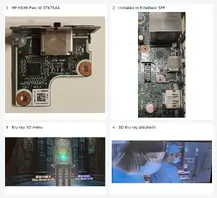
    I've attached four photos showing:

    1. The HDMI Flex IO module and its markings.
    2. The module installed in the 705 G4 SFF.
    3. The original 3D Blu-ray disc menu.
    4. The movie playing successfully.

    I've also attached the Kodi debug log from the successful test, so you can check the HDMI detection and 3D frame-packing output modes.

    This is especially interesting considering our previous discussion about DisplayPort-to-HDMI converters and LSPCON chips.

    Thanks again to everyone involved in developing this fantastic LibreELEC 13 build!

    Your work has made these inexpensive HP EliteDesk machines incredibly capable multimedia PCs! 👍HP_EliteDesk_705_G4_SFF_HDMI_3D_Log.txt

    Hi CroqueMr,

    Thanks for your explanation regarding the PS175HDM and the internal DisplayPort-to-HDMI conversion.

    However, I'd like to share one important finding from my own testing:

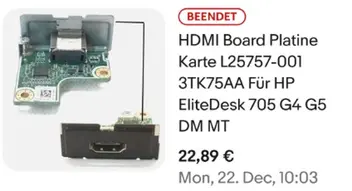
    The HDMI Flex IO module already working in my HP EliteDesk Mini is exactly the HP 3TK75AA / L25757-001 that you mentioned!

    Attached is a screenshot of my original eBay purchase:

    With the new LibreELEC 13 build, the system detects the output as HDMI-A-1, offers 1920×2205 3D frame-packing modes at 23.976 Hz, and my LG 3D plasma automatically switches into 3D mode during playback.

    So despite the internal DP-to-HDMI conversion, this particular module is already working in my Mini.

    Of course, I understand that this doesn't guarantee the same result on the 705 G4 SFF. I'll test that as soon as the additional module arrives.

    I just wanted to share this real-world result, as it might be useful for your development work.

    Thanks again for all your efforts!

    Thanks for doing the research! 👍

    Just to add some information: I bought my HP EliteDesk machines for less than €100 each, and I've found HDMI Flex IO modules on eBay for around €22.

    So these machines can be a very affordable option, especially if you already have one.

    I'll share the eBay links below. Of course, we still need to confirm which HDMI module version works with the 705 G4 SFF.


    https://ebay.io/m/RW64Ft

    https://ebay.io/m/B0gKEs

    And just as a side note: only thanks to the newly available custom LibreELEC 13 build have these inexpensive HP EliteDesk machines become such incredible multimedia powerhouses! 😃

    With 4K playback, native Blu-ray 3D frame packing via HDMI, and Kodi, they're now fantastic home theater PCs.

    And that's not all: with Batocera, they're also surprisingly capable gaming machines, including PlayStation 2 emulation!

    For around €100 for the base PC, the versatility is amazing.

    This new LibreELEC 13 build really makes all the difference.

    Many thanks to everyone involved in its development!

    Hi cinemaONE and everyone,

    I've found the official HP Maintenance and Service Guide for my HP EliteDesk 705 G4 Small Form Factor Business PC (HP document L23140-001, June 2018).

    On page 5, under Illustrated parts catalog → Option boards, HP explicitly lists:

    Quote

    HDMI option board
    DisplayPort option board
    VGA option board
    USB Type-C option board

    The manual also shows the optional rear port on page 3 and documents the option port board removal procedure on page 46.

    So HP officially confirms that an HDMI option board was available for this exact SFF model.

    However, the manual doesn't specify the exact HDMI module part number or distinguish between version 1 and version 2.

    I've already ordered an additional HDMI module and will check the part numbers and compatibility before testing it in the SFF.

    I'll report back once I've tested it.

    Thanks again for your help and research!HP_EliteDesk_705_G4_SFF_HDMI_Auszug.pdf

    Hi cinemaONE,

    Thanks again for your support and your willingness to help!

    I've ordered an additional HP HDMI Flex IO module (3TK75AA), as I'd like to equip all of my HP EliteDesk systems with the same HDMI hardware.

    Please bear with me until the module arrives. Once installed, I'll test 3D frame packing on the 705 G4 SFF and report back with the results.

    This should give us a useful comparison between the systems.

    Thanks again for your patience and help!

    Hi CroqueMr and cinemaONE,

    I have some very interesting news!

    I tested my smaller HP EliteDesk with an optional HP HDMI output module and an AMD Ryzen 5 PRO 2400GE (Vega graphics), using the same LibreELEC build.

    HDMI 3D frame packing works!

    My LG 60-inch 3D plasma TV automatically detects the 3D signal.

    The attached sanitized log confirms that the AMD driver detects the output as HDMI-A-1 and exposes the following modes:

    1920x2205 @ 24.000000 Hz 3D fp

    1920x2205 @ 23.976080 Hz 3D fp

    During playback of an original 3D Blu-ray directly from the optical drive, Kodi selects:

    Display resolution ADJUST : 1920x2205 @ 23.976080 Hz 3D fp (40)

    There are also some switches between frame packing and SBS in the log.

    This is particularly interesting because my other EliteDesk with the Ryzen 2400G and DisplayPort-to-HDMI cable only exposes DP-3, without the required frame-packing modes.

    The HDMI module's internal implementation is still unclear, but the practical result is confirmed by the LG plasma's automatic 3D detection.

    I've attached a sanitized 3D diagnostic excerpt without unrelated Add-on information.

    Could this working configuration help identify why frame packing is unavailable on the DisplayPort-based system?

    I'd still be very happy to test an experimental build if useful.

    Thank you both for your help and your excellent work!

    Hi CroqueMr,

    Thanks for your detailed explanation!

    There is one technical distinction I'd like to clarify regarding my setup.

    I'm using a passive DisplayPort-to-HDMI cable, not an active converter with an LSPCON chip.

    Assuming the connection operates in DP++ (Dual-Mode DisplayPort), the graphics hardware generates an HDMI-compatible TMDS signal directly, without an external DisplayPort-to-HDMI conversion chip.

    Wouldn't this make my setup different from the active DP-to-HDMI adapters that failed the 3D timing validation?

    I understand that the AMD kernel patch currently enables HDMI 1.4 3D frame-packing modes only on native HDMI connectors.

    However, could the HDMI-only connector check potentially be relaxed specifically for passive DP++ connections, allowing the driver to attempt the required 3D timings?

    Of course, successful link validation would still need to be verified.

    I'm happy to test an experimental kernel patch or LibreELEC build on my hardware if you're interested.

    Thanks again for your excellent work!

    Hi CroqueMr,

    Just to clarify: My DisplayPort-to-HDMI cable is passive, not active!

    It is connected directly from the DisplayPort output of my HTPC to the HDMI input of my 3D display, without any additional adapters.

    This means my setup uses DP++ (Dual-Mode DisplayPort), where the HDMI signal is generated directly by the graphics hardware.

    Since you mentioned that you could only test active adapters, my setup might be particularly interesting for testing the passive case.

    Could the HDMI-only stereo_allowed check be preventing 3D frame-packing output through this passive DP++ connection?

    Would it be possible to modify this check to allow 3D frame-packing on passive DP++ connections as well?

    I'd be happy to test a modified build if that helps!

    Thanks again for your work!

    Hi cinemaONE and CroqueMr,

    Thank you both for your explanations and for taking the time to investigate my log!

    I understand that the current AMD 3D kernel patch only exposes frame-packing modes on native HDMI connectors, while my DP-to-HDMI connection fails to provide these modes.

    Since CroqueMr mentioned that DP should be OK for 3D, I was wondering whether extending the kernel patch to support DP-to-HDMI connections might be technically feasible.

    I'd be very happy to volunteer as a test candidate for an experimental kernel patch or custom LibreELEC build.

    I've been working with Linux-based HTPCs since 2004, starting with VDR, followed by OpenELEC, LibreELEC, CoreELEC and other systems.

    My hardware is available for testing, and I can provide logs, EDID information and detailed feedback.

    The same HDMI splitter and Optoma projector already work correctly with native Blu-ray 3D from my Panasonic player.

    Of course, I understand that such a patch might require significant development work and may not be possible.

    Thanks again for your excellent work!

    Hi CroqueMr,

    Thank you for your reply and for looking into this!

    I've attached a sanitized excerpt from my Kodi log, focusing on the 3D Blu-ray playback attempt. Some unrelated entries have been removed for privacy.

    The original 3D Blu-ray (Doctor Strange) is played directly from the internal optical drive of my HP EliteDesk 705 G4 SFF (Ryzen 5 PRO 2400G / Vega 11).

    My setup is:

    DisplayPort → 30 cm 4K DP-to-HDMI cable → HDMI splitter → Optoma UHD projector

    The same HDMI splitter works correctly with my Panasonic UHD Blu-ray player, including native Blu-ray 3D and 4K output.

    One thing I noticed in the log is:

    [WHITELIST] Searching the whitelist for: width: 1920, height: 1080, fps: 23.976, 3D: true

    Followed by:

    Display resolution ADJUST : 1920x1080 @ 23.976080 Hz 3D sbs (32)

    Kodi seems to recognize the 3D content but selects SBS instead of frame packing.

    Could this be related to the available DRM display modes or the DP-to-HDMI connection?

    I'd appreciate your thoughts.

    Thanks again for your help!